
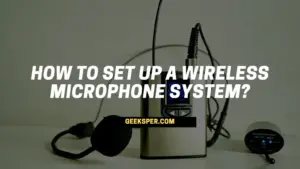
Setting up a wireless microphone system is one of the most common questions people run into when building out their own audio equipment. This guide walks through the basic setup process, what you’ll need, how frequencies work, and how the different parts of a wireless system fit together.
Quick verdict: if this is your first wireless setup, start with a single transmitter and receiver pair plus a basic mixer for monitoring. Only scale up to a multi-channel kit once you know how many simultaneous mics your stage or room actually needs.
If you’re deciding on a wireless microphone to use with this kind of system, that guide covers strong options worth pairing with the steps below.
How to Set Up a Wireless Microphone System
- Plug the power supply into the receiver, then plug it into the wall.
- Connect one end of your XLR cable to the receiver, and the other end to your microphone for the room or PA system. If you’re using a lavalier mic, you’ll connect it directly to the transmitter instead.
- Press and hold the mute button on the microphone until the light turns green. You should see the corresponding light on your receiver turn green as well.
- Adjust the input volume for the room or PA system as needed.
What Do You Need for a Wireless Microphone System?
You’ll need the following to set up a wireless microphone system:
- A transmitter and receiver
- A mixer or preamp
- An antenna and RF cable for your receiver, especially if you’re placing it in a different room or further from the transmitter
- XLR cables, headphones if needed, a wireless mic stand if needed, and an amp if you’re using the system as part of a larger PA setup
Some transmitters can also function as AB amplifiers when connected to larger speaker cabinets, plugging into the LINE OUT L/MONO or R jacks using a standard guitar cable. Check your transmitter’s manual for specifics on this.
For a basic wireless system, you’ll need one transmitter and one receiver. Reliable options include the Shure ULXD4/H4, which is notably stronger than older UHF-series models, or the AKG WMS470R. If you’re planning a larger PA setup with four wireless mics plus instruments, you’ll want two of each as your starting kit.
You’ll also need a mixer or preamp if you’re not using DAW software. A single-channel mixer works fine for personal monitoring, but make sure it has enough outputs to handle all your inputs cleanly. For more flexibility, an 8-output channel mixer, like Behringer’s XENYX 802, is a solid choice that gives you more room to lay out a full PA system without overspending.
How Do You Set Up Wireless Microphone Frequencies?
There are two main things to consider when setting up wireless frequencies: how many simultaneous channels you need, and how far apart the microphones will be from each other.
For example, if you’re working with a large stage that needs four mics for vocalists positioned at opposite ends, it may make sense to set them all to the same channel or frequency. If the stage is smaller, each microphone can run on its own channel, as long as they all stay within range of each other to avoid dropouts or interference.
What Frequency Should You Use?
Most wireless mics operate in either VHF (very high frequency), typically 170MHz to 270MHz, or UHF (ultra-high frequency), typically 470MHz to 608MHz.
How Do You Connect a Wireless Microphone to a Computer?
There are two main approaches here. The first is connecting the receiver directly to a USB port on your computer. It’s generally best to use a dedicated USB port rather than one already in use by a keyboard or mouse.
The second approach is through an audio interface, such as a mixer with digital inputs. If you’re not familiar with how these work, our guide on what an audio interface is covers this in detail.
The right method for your setup depends on how many channels your wireless system has and how many input ports are available on your computer.
How Do Wireless Microphones Work?
Microphones let human voices be heard without relying purely on the natural vibration of air produced by vocal cords. For sound to reach an intended listener, it has to travel through a medium, like air, the way it does when someone speaks to you directly nearby.
With a wireless system, that communication happens through electromagnetic waves rather than relying solely on air vibration across space. The person speaking sends their voice into the transmitter at one end, and the receiver at the other end converts that signal back into audible sound.
Wireless microphones operate in one of two frequency categories: VHF or UHF. Each has its own advantages. Most FM radio stations use VHF, which generally covers more distance than UHF because lower frequencies travel further before being blocked by obstacles like buildings or trees.
Parts of a Wireless Microphone System
Transmitters
The transmitter captures whatever you’re speaking or singing into it, then sends that information to the receiver. Once received, it converts your voice back into sound that listeners can hear through the receiver.
Receivers
Receivers take incoming transmissions from the transmitter and translate them back into clear voice and sound for listeners.
Batteries
Batteries power both the transmitter and receiver in a wireless system. Most wireless mic batteries are rechargeable, since they get used repeatedly across performances or recording sessions.
Conclusion
Setting up a wireless microphone system comes down to a few core steps: connecting your transmitter and receiver, choosing the right frequency setup for your space, and making sure your mixer or audio interface handles all your inputs cleanly.
For more on related setup topics, see our guides on what a condenser microphone is, easy hacks to improve microphone sound quality, what does a pop filter do, and how to stop microphone from picking up keyboard noise.