
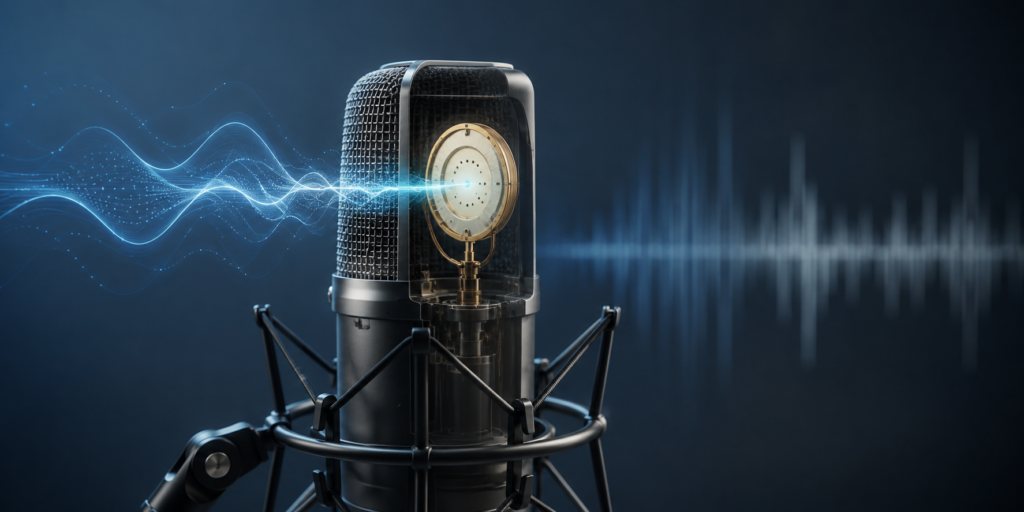
A condenser microphone is a sensitive microphone that uses a thin diaphragm and a backplate to convert sound waves into an electrical signal. It is the standard choice for studio vocals, podcasts, voiceovers, acoustic instruments, ASMR, and any recording where capturing fine detail matters.
If you’ve ever wondered why a studio microphone costs more and sounds noticeably different from a basic headset mic, the answer usually comes down to the condenser design. We’ve recorded vocals with both condenser and dynamic mics in the same room, and the condenser consistently picks up more nuance, more air around the voice, and more texture in the performance. That sensitivity is its biggest strength and its biggest tradeoff.
For more context on where condenser microphones fit within the broader landscape, see our guides on what a microphone is, types of microphones, and how a microphone works.
What Does a Condenser Microphone Do?
A condenser microphone’s core job is the same as any microphone: turning sound into an electrical signal. What makes it distinct is how well it does that job at low volume levels and across a wide frequency range.
Specifically, a condenser microphone:
- Captures detailed, accurate sound across a wide frequency range
- Records vocals with clarity and natural-sounding air and texture
- Picks up quiet sounds that a dynamic microphone would miss or flatten
- Works well in studio and controlled room environments
- Needs power to operate, either phantom power, a battery, or USB
- Captures more of the room around you, which is a tradeoff to manage
That last point matters. The same sensitivity that lets a condenser mic hear every detail of your voice also means it hears every fan, every car outside, and every keyboard click. A clean room setup is part of what makes a condenser mic work well.
How Does a Condenser Microphone Work?
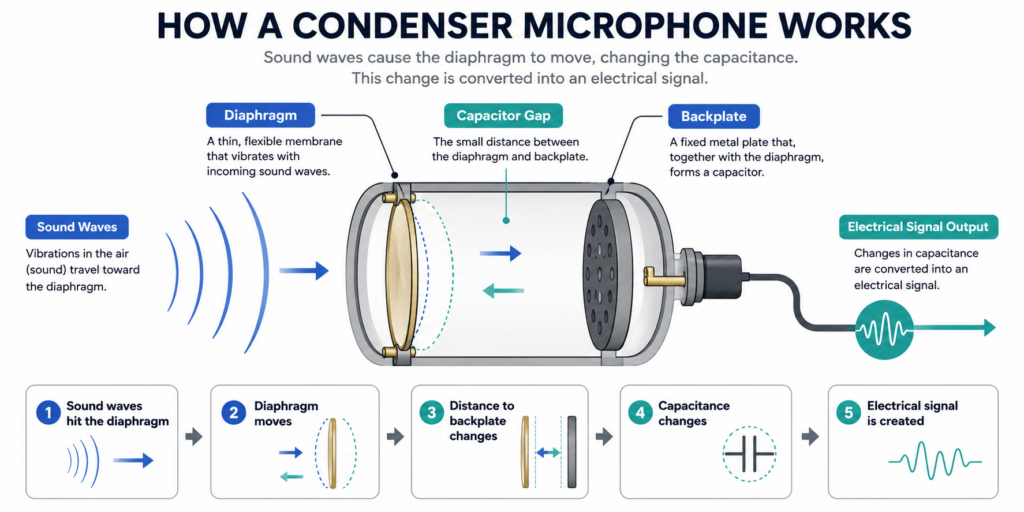
Sound Waves Hit the Diaphragm
When you speak or sing, sound waves travel outward and reach the microphone’s diaphragm, a very thin, lightweight membrane. Because condenser diaphragms are designed to be as light and responsive as possible, they move in response to even very quiet sound pressure changes.
The Diaphragm and Backplate Create Electrical Changes
Behind the diaphragm sits a fixed metal plate called the backplate. Together, the diaphragm and backplate function like a capacitor, two charged plates separated by a small gap. When sound moves the diaphragm, the distance between the diaphragm and the backplate changes, and that changing distance creates a changing electrical charge, which becomes the audio signal.
This capacitor-based design is exactly what gives condenser microphones their name. “Condenser” is an older term for capacitor.
The Signal Is Powered and Amplified
Because this electrical change is extremely small on its own, condenser microphones include an internal amplifier circuit that boosts the signal to a usable level. That amplifier needs power, which is why condenser microphones require an external power source. For most XLR condenser microphones, that power comes as phantom power, typically delivered at 48V through a balanced XLR cable from an audio interface or mixer. For USB condenser microphones, the computer provides the power directly. Some smaller condenser mics use a battery instead.
For more on how phantom power works and which devices supply it, see our guide on what phantom power does.
Main Parts of a Condenser Microphone
Diaphragm
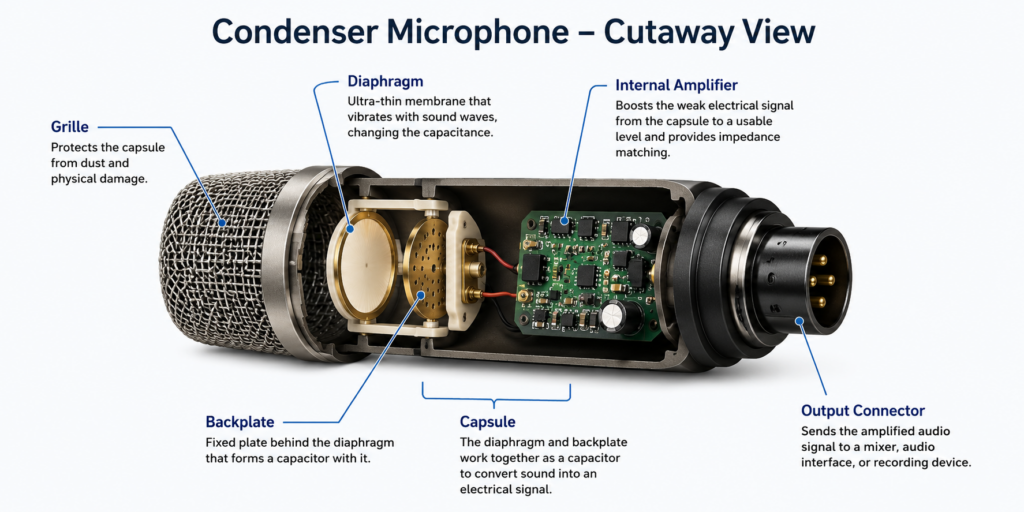
The thin, lightweight membrane that moves in response to sound waves. Larger diaphragms tend to capture a warmer, more detailed sound. Smaller diaphragms tend to be more accurate and consistent across a wider range of frequencies.
Backplate
The fixed metal plate behind the diaphragm. Together with the diaphragm, it forms the capacitor that generates the electrical signal.
Capsule
The complete assembly of diaphragm and backplate. This is the core sound-capturing component of the microphone.
Internal Amplifier
The circuit inside the microphone that boosts the small signal from the capsule to a level other devices can work with. This is why condenser mics need power and why they’re more complex internally than dynamic mics.
Output Connector
Where the signal exits the microphone. XLR is the standard for professional studio use. USB is common on beginner-friendly and computer-based models.
Types of Condenser Microphones
Condenser microphones are not all the same. They come in a few distinct subtypes, each suited to a different recording situation.
Large-Diaphragm Condenser Microphone
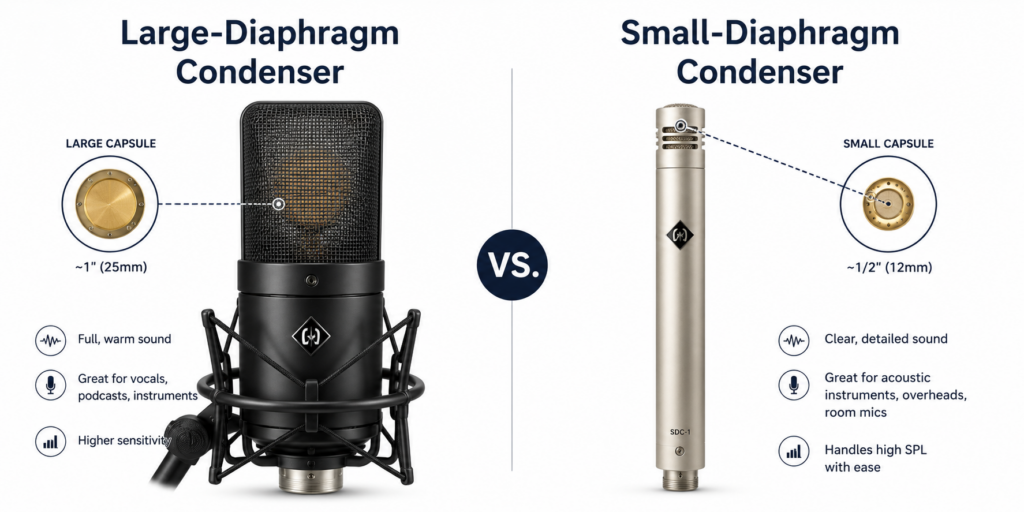
The large-diaphragm condenser is the most common studio microphone type. Its larger capsule captures a warm, detailed, full sound that works particularly well for lead vocals, spoken-word podcasting, voiceovers, and close-miked acoustic instruments. Our guide to best large-diaphragm condenser microphones covers strong options across different budgets.
Small-Diaphragm Condenser Microphone
Small-diaphragm condensers sacrifice some warmth in exchange for more accurate, consistent pickup across a wider frequency range. They’re the standard choice for acoustic guitar, piano, drum overheads, orchestral instruments, and situations where accuracy matters more than character.
USB Condenser Microphone
A USB condenser microphone uses the same capacitor-based design as a studio condenser, but with a built-in analog-to-digital converter that lets it connect directly to a computer. No audio interface is needed. This makes USB condensers the most accessible entry point into condenser recording for podcasters, streamers, and beginners.
Shotgun Condenser Microphone
Shotgun microphones typically use a condenser capsule in a highly directional design. For more on how they work and where they’re used, see our guide on what a shotgun microphone is.
Condenser Microphone Uses
| Use Case | Is Condenser Good? | Why |
|---|---|---|
| Studio vocals | Yes | Captures detail and clarity |
| Podcasting | Yes, in quiet rooms | Clear voice quality |
| YouTube videos | Yes | Better voice detail than built-in mics |
| ASMR | Yes | Very sensitive to quiet sounds |
| Acoustic guitar | Yes | Captures natural tone and transient detail |
| Live stage | Sometimes | Can pick up more feedback than dynamic mics |
| Noisy room | Not ideal | Captures background noise along with the source |
Pros and Cons of Condenser Microphones
- Captures clear, detailed, accurate sound
- Excellent for vocals, voiceovers, and acoustic instruments
- More sensitive than dynamic microphones, making quiet sounds register clearly
- Better suited for studio recording and controlled environments
- Responds quickly to fast sound changes like consonants and instrument attacks
- Wide frequency response means the recording sounds natural and full
- Requires phantom power, a battery, or USB power to operate
- Picks up more ambient and background room noise than dynamic mics
- More physically delicate than dynamic microphones
- Not always the best choice in untreated rooms where echo and noise are present
- Can distort if the input gain is set too high
- Generally more expensive than comparable dynamic microphones
Condenser Microphone vs Dynamic Microphone
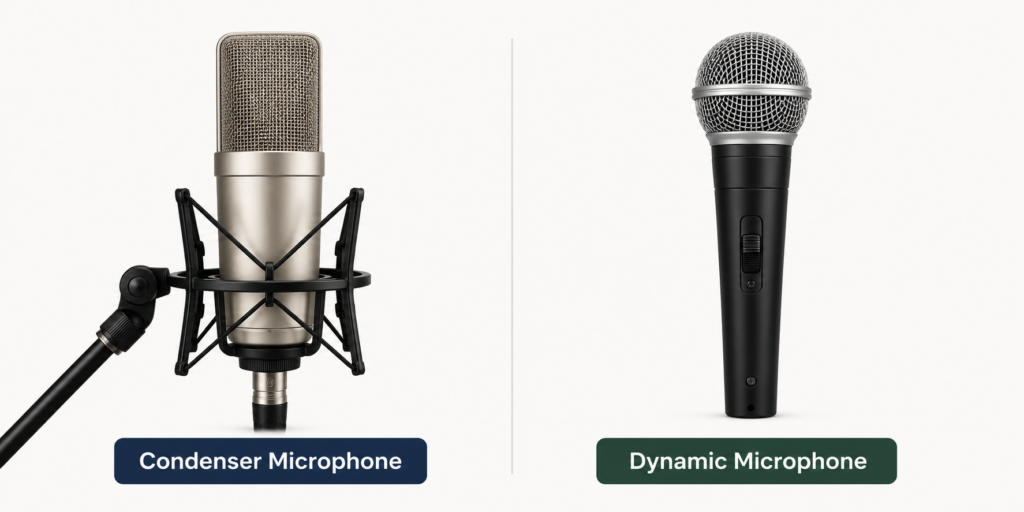
| Feature | Condenser Microphone | Dynamic Microphone |
|---|---|---|
| Sensitivity | Higher | Lower |
| Power needed | Usually yes | Usually no |
| Best for | Studio vocals, detail, quiet sounds | Live vocals, loud sound, noisy rooms |
| Room noise | Picks up more | Picks up less |
| Durability | More delicate | More durable |
| Beginner use | Best in quiet rooms | Best in noisy rooms |
A condenser microphone is the stronger choice when detail, accuracy, and clarity are the goal. A dynamic microphone is the stronger choice when the environment is noisy, loud, or less controlled. Neither is universally better; they’re designed for different conditions.
Do You Need Phantom Power for a Condenser Microphone?
Most XLR condenser microphones need phantom power, which is typically 48V DC delivered through a balanced XLR cable from an audio interface or mixer. This is usually a switch or button on the interface labeled “48V.” It doesn’t need to be added separately; it’s built into most audio interfaces.
USB condenser microphones get their power directly from the computer through the USB connection, so no external phantom power is needed.
Some smaller condenser microphones, particularly lavalier-style condensers and older broadcast models, use an internal battery instead.
If your audio interface doesn’t supply phantom power and you want to use an XLR condenser mic, you’ll need a separate phantom power supply. For more on how all of this connects, see our guide on what an audio interface is.
Should You Buy a Condenser Microphone?
A condenser microphone is the right choice if you record in a quiet room and want detailed, professional-sounding audio. It’s a strong fit for:
- Studio vocal recording
- Podcasting in a treated or quiet space
- Voiceover and narration work
- Acoustic instrument recording
- ASMR content
- YouTube videos where voice clarity matters
A dynamic microphone is usually the better choice if your room has fan noise, traffic noise, mechanical keyboard noise, HVAC hum, or noticeable echo. In those environments, a condenser will pick up everything in the room, not just your voice.
For buying guidance, our guide to best condenser microphones for vocals covers strong picks at different price points.
Final Answer
A condenser microphone is a sensitive microphone that uses a diaphragm and backplate to turn sound waves into an electrical signal. It is best for detailed recording, studio vocals, voiceovers, podcasts, acoustic instruments, and quiet recording spaces. Most XLR condenser microphones need phantom power. USB models get power from the computer. The tradeoff for that sensitivity is that condenser mics also pick up more of the room around you, which makes acoustic treatment and mic placement genuinely important.
FAQ
What is a condenser microphone in simple words?
A condenser microphone is a sensitive microphone that captures detailed sound using a thin diaphragm, a backplate, and a powered internal circuit.
What is a condenser microphone used for?
A condenser microphone is used for studio vocals, podcasts, voiceovers, acoustic instruments, ASMR, and any recording where capturing fine detail and clarity matters.
Does a condenser microphone need phantom power?
Most XLR condenser microphones need phantom power, typically 48V from an audio interface or mixer. USB condenser microphones get power from the computer directly and don’t need external phantom power.
Is a condenser microphone good for podcasting?
Yes, in a quiet or acoustically treated room. In a noisy or echoey room, a dynamic microphone is usually the better choice because it rejects background noise more effectively.
What is the difference between condenser and dynamic microphones?
A condenser microphone is more sensitive and captures more detail, but picks up more room noise and needs power to operate. A dynamic microphone is more durable, rejects background noise better, and usually doesn’t need external power.
Is a condenser microphone good for vocals?
Yes. A condenser microphone is excellent for vocals because it captures clarity, detail, and natural tone, especially in a controlled recording environment.