

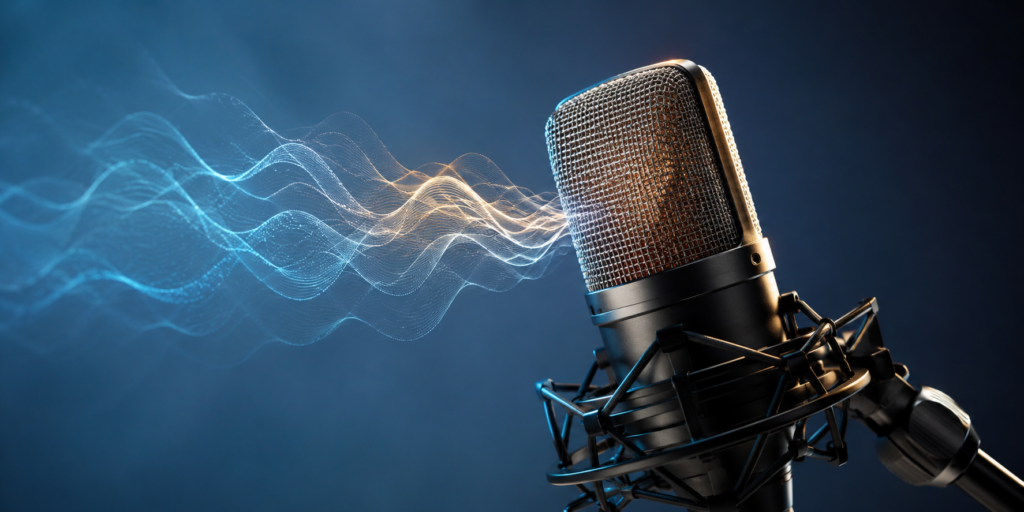
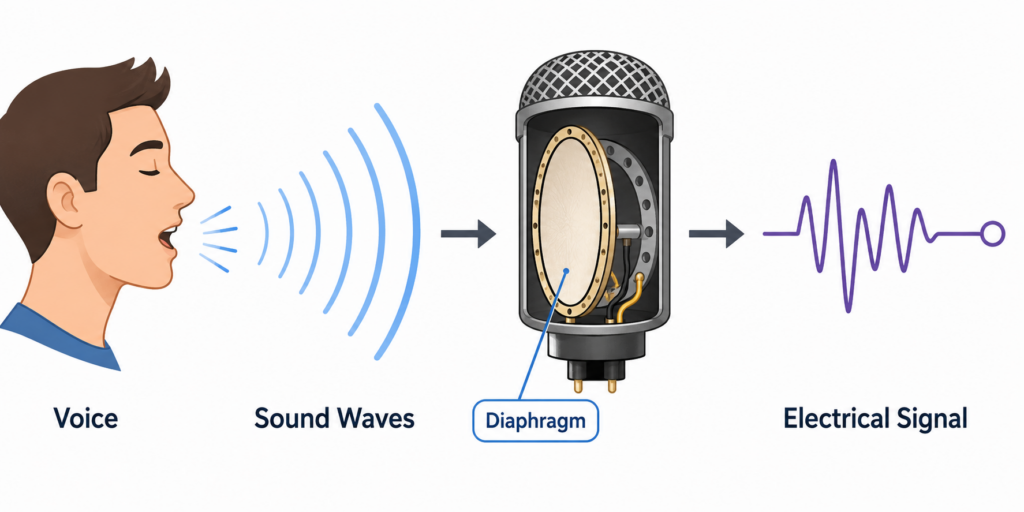
A microphone works by converting sound waves into an electrical signal. When you speak, sing, or play an instrument, those sound waves hit a thin part inside the microphone called a diaphragm. The diaphragm vibrates, and the microphone turns that vibration into an electrical signal that can be recorded, amplified, or sent on to another device.
That’s true whether you’re talking into a podcast microphone, a phone, a gaming headset, a studio mic, a stage mic, a laptop’s built-in mic, or a camera mic. The basic principle never changes, even though the internal mechanics do. This guide walks through exactly how that conversion happens, step by step, and what occurs once your voice has become an electrical signal.
For a broader overview of what a microphone is and the different types available, see our guides on what a microphone is and types of microphones.
What Happens Inside a Microphone?
Before getting into the mechanical detail, it helps to see the whole process laid out simply:
- Sound is created by vibration.
- Sound waves travel through the air.
- The waves reach the microphone.
- The diaphragm moves.
- That movement becomes an electrical signal.
- The signal travels on to a recorder, speaker, mixer, interface, phone, or computer.
Every microphone type follows this same six-step path. Where they differ is in how step 5 actually happens, and that difference is what gives dynamic, condenser, and ribbon microphones their distinct sound and behavior.
Step-by-Step: How a Microphone Converts Sound Into a Signal
Step 1: Sound Waves Travel Through the Air
Sound itself is vibration, moving through the air as rapid pressure changes. Your voice creates these waves. So does a guitar string, a drum hit, the hum of a room’s air conditioning, or someone typing nearby. A microphone can’t tell the difference between the sound source you want and the one you don’t, which is part of why mic placement and room setup matter so much in practice.
Step 2: Sound Waves Hit the Diaphragm
The diaphragm is a thin, lightweight surface inside the microphone, often made of plastic film, thin metal, or in the case of a ribbon mic, a strip of corrugated foil. When sound pressure waves reach it, the diaphragm physically moves back and forth in response, tracking the shape of the sound wave as closely as its design allows.
Step 3: The Diaphragm Movement Creates an Electrical Change
This is where microphone types genuinely diverge. A dynamic microphone uses a coil and magnet. A condenser microphone uses changes in capacitance between a diaphragm and backplate. A ribbon microphone uses a thin metal ribbon moving inside a magnetic field. Each method produces the same basic outcome, an electrical signal, but the character of that signal differs noticeably between designs.
Step 4: The Signal Travels Out of the Microphone
Once generated, that signal is weak, far too weak to use directly. It travels out of the microphone through whatever connector the mic uses, commonly USB, XLR, 3.5mm, TRRS, or a wireless transmitter.
Step 5: The Signal Is Amplified, Recorded, or Played Back
From there, the signal heads to wherever it needs to go next: an audio interface, a mixer, an amplifier, a computer, a camera, a phone, a recorder, a speaker, or headphones. What happens at this stage depends entirely on your setup, but the signal itself is now ready to be boosted, processed, or saved.
Main Parts That Help a Microphone Work
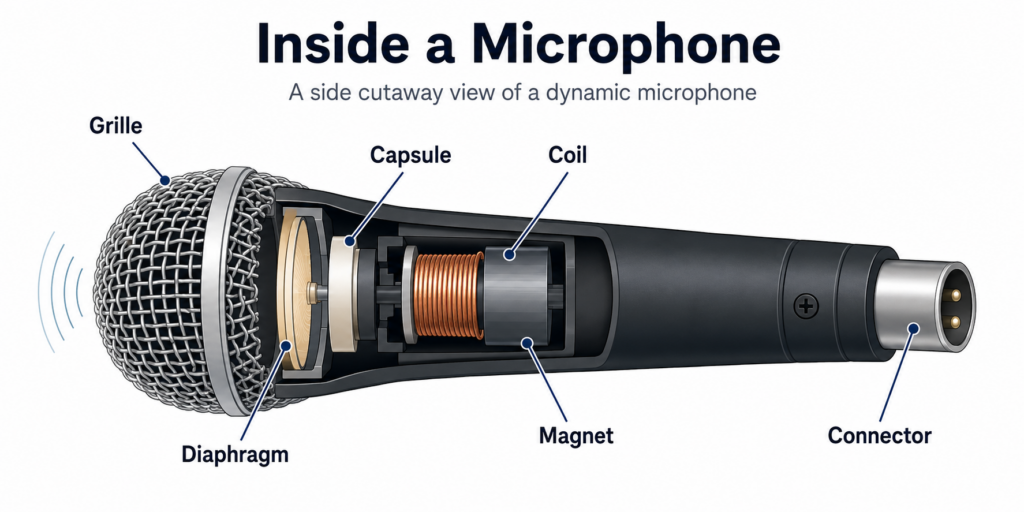
Diaphragm
The diaphragm is the part that physically moves when sound waves reach it. Without it, nothing else in the microphone has anything to react to.
Capsule or Transducer
The capsule is the sound-converting section of the microphone, the part that actually turns acoustic energy into electrical energy. The diaphragm lives inside the capsule.
Voice Coil
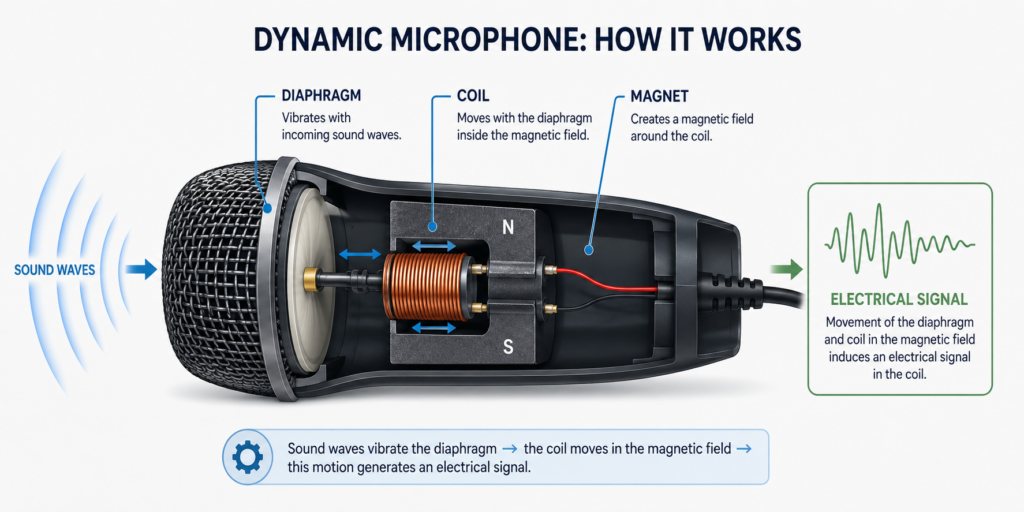
In a dynamic microphone, the voice coil is attached directly to the diaphragm and moves with it.
Magnet
The magnet creates a magnetic field. As the voice coil moves through that field, it generates a small electrical current, a process called electromagnetic induction.
Backplate or Capacitor
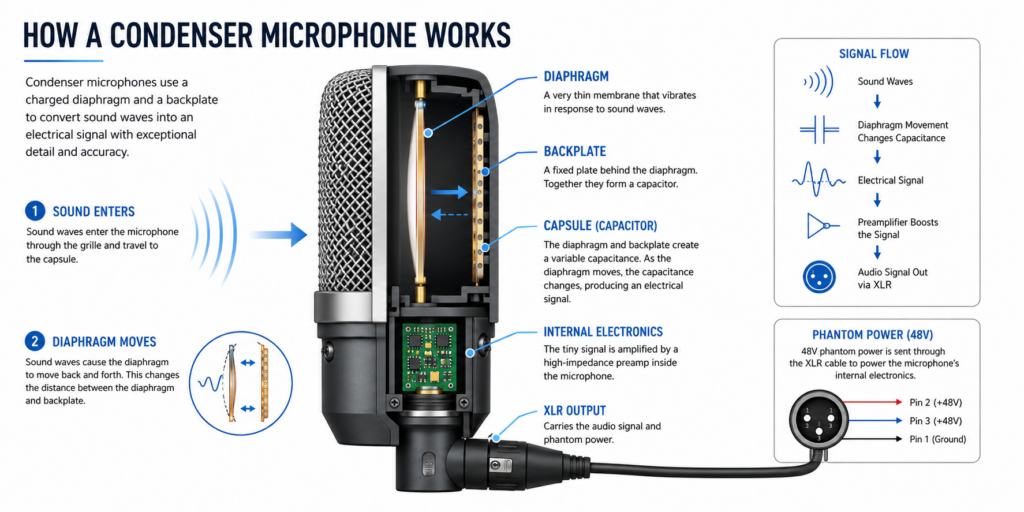
In a condenser microphone, the diaphragm sits close to a fixed backplate. Together, they function like a capacitor. As the diaphragm moves, the distance between it and the backplate changes, and that changing distance is what creates the electrical signal.
Output Connector
The connector sends the finished signal out to another device. Common outputs include USB, XLR, 3.5mm, and wireless transmission systems.
How Does a Dynamic Microphone Work?
A dynamic microphone works through electromagnetic induction, the same basic principle a generator uses, just on a tiny scale. It has a diaphragm, a voice coil, and a magnet. When sound moves the diaphragm, the attached coil moves with it inside the magnet’s field, and that movement generates a small electrical signal directly, with no external power required.
Best uses: Live vocals, stage performance, podcasting, loud instruments, gaming, untreated rooms.
- Durable
- Handles loud sound well
- Doesn't need phantom power
- Good for noisy rooms
- Usually needs more gain to reach a strong signal level
- Less sensitive than condenser microphones
- Captures less fine detail
How Does a Condenser Microphone Work?
A condenser microphone works through capacitance rather than magnetism. Its diaphragm sits near a fixed backplate, and together they act like a capacitor. When sound moves the diaphragm, the distance between it and the backplate changes, and that change creates the electrical signal. Because this process needs an electrical charge to begin with, condenser microphones generally require external power, almost always supplied as phantom power or, in some smaller models, a battery.
Best uses: Studio vocals, podcasting in a treated room, voiceovers, acoustic instruments, detailed recording, ASMR, controlled rooms.
- Captures more detail
- More sensitive
- Better for quiet sounds
- Clear, accurate studio sound
- Usually needs phantom power
- Picks up more room noise
- More sensitive to a poorly treated recording space
How Do Other Microphone Types Work?
How Does a Ribbon Microphone Work?
A ribbon microphone uses a thin strip of corrugated metal suspended in a magnetic field instead of a diaphragm and coil. Sound moves the ribbon, and that movement creates the electrical signal. This design is largely responsible for the warm, smooth, slightly vintage character ribbon mics are known for.
How Does a Lavalier Microphone Work?
A lavalier microphone works the same way internally as a small condenser or electret capsule, just clipped close to a speaker’s mouth. Its small size and consistent positioning make it well suited for interviews, presentations, and on-camera video.
How Does a USB Microphone Work?
A USB microphone captures sound the same way any other mic of its underlying type does, but it also includes a built-in analog-to-digital converter. That converter turns the signal into digital audio before it leaves the microphone, sending it straight to a computer without needing a separate interface.
How Does a Wireless Microphone Work?
A wireless microphone captures sound and converts it into a signal the same way a wired mic does. The difference comes after that: instead of traveling through a cable, the signal goes to a transmitter, which sends it over radio frequency to a separate wireless receiver.
Dynamic vs Condenser Microphone Working Difference
| Feature | Dynamic Microphone | Condenser Microphone |
|---|---|---|
| Main working method | Coil moves in a magnetic field | Diaphragm and backplate change capacitance |
| Power needed | Usually none | Usually phantom power or battery |
| Sensitivity | Lower | Higher |
| Best for | Loud sound, stage, podcasting | Studio vocals, detailed recording |
| Room noise pickup | Usually less | Usually more |
| Durability | More durable | More delicate |
| Beginner use | Good for noisy rooms | Good for treated rooms |
What Happens After the Microphone Creates the Signal?
Once your microphone has generated a signal, it generally follows a path like this:
Microphone → cable or wireless system → preamp → audio interface or mixer → computer, recorder, speaker, or headphones
A few quick notes on what each stage actually does:
- A preamp boosts the weak signal coming straight out of the microphone to a usable level
- An audio interface converts that analog signal into digital audio your computer can work with
- A computer records, edits, or processes the resulting audio
- A speaker converts the electrical signal back into sound waves you can actually hear
Why Do Microphones Sound Different?
Even two microphones of the same type can sound noticeably different. A few factors that drive this:
- Diaphragm size
- Microphone type (dynamic, condenser, ribbon)
- Polar pattern
- Frequency response
- Sensitivity
- Distance from your mouth
- Room noise and acoustics
- Gain setting
- Whether you’re using a pop filter or windscreen
- USB vs XLR setup
These factors are also why two people can use the exact same microphone and get noticeably different results, since technique and room setup matter just as much as the hardware itself.
Simple Example: How Your Voice Becomes Recorded Audio
When you speak into a podcast microphone, your voice creates sound waves. Those waves hit the diaphragm. The diaphragm vibrates. The microphone converts that vibration into an electrical signal. The signal travels out through USB or XLR. Your computer receives it and saves it as digital audio.
That’s the entire process, start to finish, every time you record anything.
Final Answer
A microphone works by turning sound waves into an electrical signal. Sound moves a diaphragm inside the microphone, and depending on the design, the microphone uses a coil and magnet, a capacitor, or a ribbon to convert that movement into a signal that can be recorded, amplified, processed, or played back through speakers.
FAQ
How does a microphone work in simple words?
A microphone works by changing sound waves into an electrical signal that can be recorded, amplified, or sent to another device.
What part of a microphone picks up sound?
The diaphragm picks up sound, since it’s the part that physically vibrates when sound waves hit it.
How does a dynamic microphone work?
A dynamic microphone works when sound moves a diaphragm and its attached coil inside a magnetic field, generating an electrical signal directly.
How does a condenser microphone work?
A condenser microphone works when sound moves a diaphragm near a charged backplate, and the resulting change in distance between them creates an electrical signal.
Does a microphone need power to work?
Dynamic microphones usually don’t need external power. Condenser microphones usually need phantom power, a battery, or USB power to operate.
Is a microphone like a speaker in reverse?
A dynamic microphone is genuinely similar to a speaker in reverse, since both rely on the relationship between a moving coil and a magnetic field, just running in opposite directions.