
If you’ve ever stood in front of a wall of microphones at a store, or scrolled through dozens of options online, you already know the problem: they all promise “clear sound,” but they’re not built for the same job. A mic that’s perfect for screaming into on stage will sound thin and harsh in a quiet podcast booth. A mic that captures every breath and detail in a studio will fall apart the moment you take it outdoors into wind.
We’ve used a fair number of these side by side over the years, and the difference isn’t subtle once you know what to listen for. This guide breaks down the main types of microphones, what each one is genuinely good at, where each one falls short, and how to match the right type to what you’re actually trying to record.
For the basics of how a microphone works in the first place, see our guide on what a microphone is.
What Are the Main Types of Microphones?
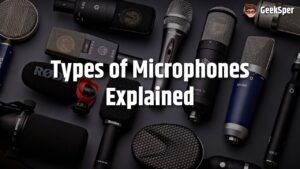
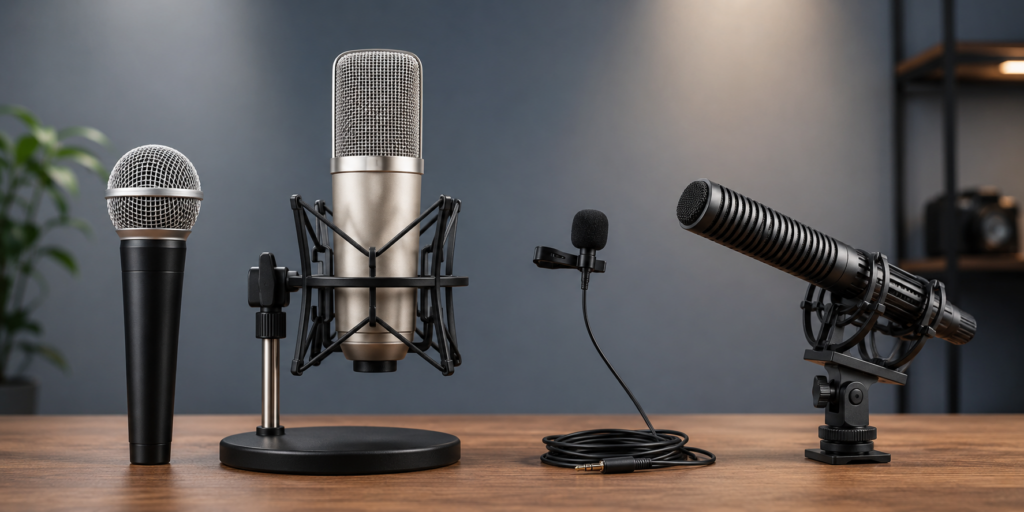
Microphones are generally grouped by how they convert sound into an electrical signal, which is the transducer type, and then further by their physical design and intended use case. The most common types you’ll run into are dynamic, condenser, ribbon, lavalier, shotgun, USB, wireless, and boundary microphones.
Each type makes tradeoffs between durability, sensitivity, cost, and how it’s meant to be positioned. None of them is universally “the best” microphone. The right one depends entirely on what you’re recording and where.
Dynamic Microphones
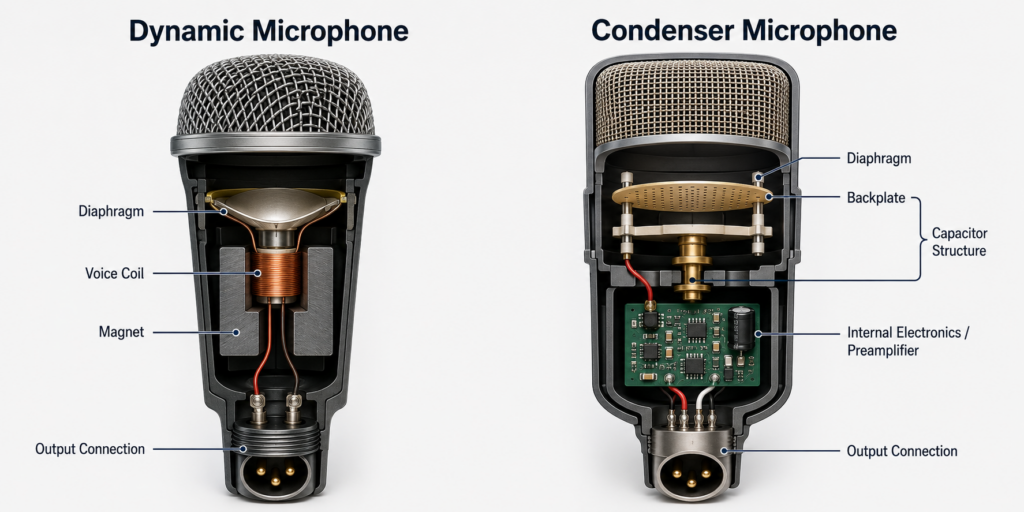
A dynamic microphone uses a simple, rugged design: a diaphragm attached to a coil of wire sitting inside a magnetic field. When sound moves the diaphragm, the coil moves with it, generating an electrical signal directly, no external power required.
That simplicity is exactly why dynamic mics have stuck around for decades. In our experience, they’re the mic you reach for when you don’t want to babysit your recording environment, since they’re naturally less sensitive to background noise and handle loud sources without distorting.
Key specs and traits: No phantom power needed. Generally handles high sound pressure levels well. Frequency response tends to be narrower and more focused on the vocal range compared to condensers.
- Durable and able to handle rough handling
- Doesn't require phantom power
- Naturally rejects more background noise
- Handles loud sound sources without distorting
- Generally more affordable
- Less detailed and less sensitive than a condenser mic
- Narrower frequency response, which can make quiet or nuanced sound feel flatter
- Not ideal for capturing subtle studio detail
Best for: Live vocals, stage performance, podcasting in untreated rooms, loud instruments like guitar amps and drums.
For a deeper look at this type specifically, see our guide on what a dynamic microphone is.
Condenser Microphones
A condenser microphone works differently. Instead of a magnet and coil, it uses two charged plates, one fixed and one that moves as a diaphragm. That movement changes the capacitance between the plates, which creates the electrical signal. This design requires power, almost always supplied as phantom power from an audio interface or mixer.
The payoff for that extra complexity is sensitivity. Condenser mics pick up far more detail and nuance than dynamic mics, which is why they’re the standard choice in recording studios. The tradeoff is that they pick up everything else in the room too, including the hum of an AC unit or someone typing two rooms over.
Key specs and traits: Requires phantom power (typically 48V) or battery power. Wider, flatter frequency response than most dynamic mics. More sensitive, meaning quieter sounds register more clearly, but so does room noise.
- Captures detailed, accurate, natural-sounding audio
- Wide frequency response
- Excellent for vocals and acoustic instruments
- Standard choice across professional studios
- Picks up more ambient and background noise
- Requires phantom power or a battery
- More delicate than dynamic mics
- Generally pricier at comparable quality levels
Best for: Studio vocal recording, podcasting in a treated room, acoustic instruments, voiceover work.
For more detail, see our guide on what a condenser microphone is.
Ribbon Microphones
A ribbon microphone is a variation on the dynamic design, using a thin strip of corrugated metal (the “ribbon”) suspended in a magnetic field instead of a diaphragm and coil. That ribbon is extremely thin and light, which gives ribbon mics a distinctively warm, smooth character that a lot of engineers describe as more natural or vintage-sounding than either dynamic or condenser mics.
That same thinness is also the tradeoff. Ribbon mics are physically delicate, and older models in particular can be damaged by a sudden gust of air, like an unexpected blast of phantom power or a strong pop from someone speaking too close.
- Distinctive warm, smooth tonal character
- Excellent for capturing natural-sounding vocals and instruments
- Often very good at handling loud sources without harshness
- More fragile than dynamic or condenser mics
- Generally more expensive
- Some older or vintage-style models can't safely take phantom power
Best for: Studio vocals, guitar amps, brass instruments, anywhere a warmer, less clinical sound is the goal.
For more on how this type works, see our guide on what a ribbon microphone is.
Lavalier Microphones
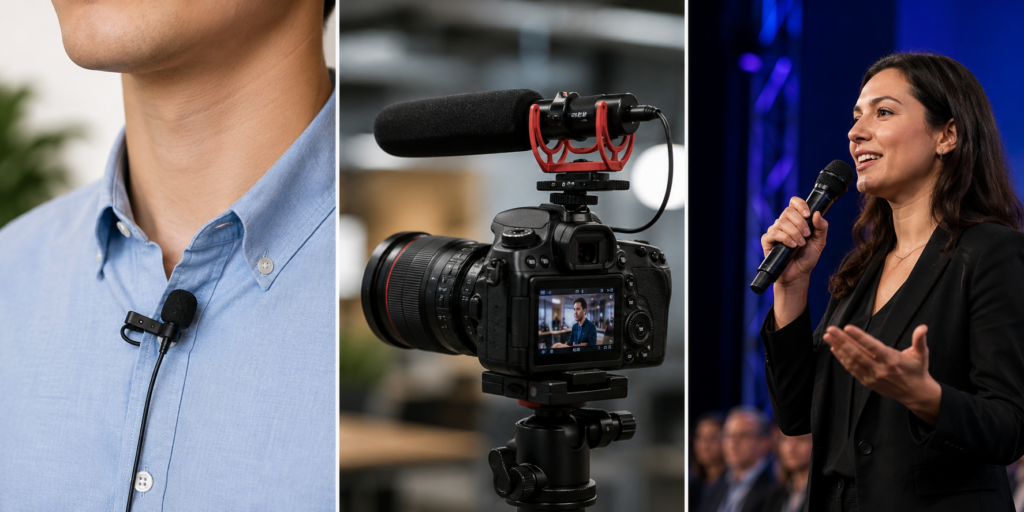
A lavalier microphone, often just called a “lav mic,” is a small clip-on mic designed to attach to clothing near the chest or collar. It’s built for hands-free speaking, which makes it the standard choice for on-camera interviews, presentations, and any situation where a handheld or stand-mounted mic would get in the way.
Most lavaliers use an omnidirectional pickup pattern, since the mic stays at a consistent distance from the speaker’s mouth regardless of head movement. That convenience comes with a real tradeoff: an omnidirectional mic also captures more of the surrounding room.
- Hands-free and unobtrusive on camera
- Consistent distance from the mouth regardless of movement
- Compact and easy to travel with
- Omnidirectional pickup means more ambient noise
- Easy to bump or cause fabric rustling against the mic
- Generally not suited for music or singing
Best for: Interviews, presentations, YouTube videos, courses, on-camera hosting.
For more, see our guide on what a lavalier microphone is.
Shotgun Microphones
A shotgun microphone is a highly directional mic built to capture sound from directly in front of it while rejecting noise from the sides and rear. The name comes from its long, tube-like body, which uses interference tubes along its length to cancel out off-axis sound.
This makes shotgun mics the standard choice for film and video production, since they can be mounted on a camera or boom pole and aimed precisely at a subject, even from a few feet away, without picking up much of the surrounding environment.
- Excellent at isolating a single sound source
- Works well at a distance, unlike most other mic types
- Strong choice for noisy or outdoor environments
- Needs to be aimed accurately to work well
- Less natural-sounding for music or singing
- Often requires a boom pole, mount, or external recorder setup
Best for: Film, vlogging, documentary-style video, outdoor interviews, run-and-gun video production.
For more, see our guide on what a shotgun microphone is.
USB Microphones
A USB microphone isn’t really a separate transducer type, it’s typically a condenser (occasionally dynamic) capsule paired with a built-in analog-to-digital converter, so it can plug directly into a computer without needing a separate audio interface. This makes USB mics the easiest entry point into recording for anyone who doesn’t already own studio gear.
In our experience, this is the right starting point for most beginners specifically because it removes a whole layer of setup complexity. The tradeoff is flexibility: a USB mic is generally locked to a single device at a time, and it won’t integrate into a more advanced multi-mic setup the way an XLR mic will.
- Plug-and-play, no separate interface needed
- Genuinely beginner-friendly
- Often includes built-in headphone monitoring
- Widely available at a range of price points
- Less flexible than XLR for multi-mic or professional setups
- Generally not field-upgradeable the way XLR systems are
- Quality varies a lot between budget and premium models
Best for: Podcasting, gaming, streaming, Zoom calls, beginners getting started with recording.
Our guide to best USB microphones under $100 covers strong entry-level picks if you’re shopping for one. For more on how USB compares to a traditional XLR setup, see our guide on USB vs 3.5mm microphone.
Wireless Microphones
A wireless microphone removes the cable entirely, using a transmitter and a separate wireless microphone receiver to send the audio signal over radio frequency instead. This gives a performer or speaker full freedom of movement, which is exactly why wireless systems are standard for live events, fitness instruction, and theater.
The underlying microphone capsule in a wireless system can be dynamic, condenser, or lavalier-style; “wireless” really just describes the transmission method, not the sound-capture design itself.
- Complete freedom of movement
- No cables to manage or trip over
- Works well across stage, events, and fitness settings
- Battery life is a constant consideration
- Signal interference is possible in crowded RF environments
- Generally pricier than an equivalent wired mic
Best for: Live events, stage performance, fitness instruction, theater, presentations requiring mobility.
For setup details, see our guide on how to set up a wireless microphone system.
Boundary Microphones
A boundary microphone is designed to be placed flat on a surface, like a table or floor, rather than mounted on a stand. It uses the surface itself as part of its pickup design, which lets it capture sound evenly across a room without needing to be pointed at any one person.
This makes boundary mics a strong fit for conference rooms, courtrooms, and theater stages, where you need to capture multiple speakers without a forest of individual microphones.
- Captures sound evenly across a room or table
- Low profile and unobtrusive
- Good for multiple speakers without multiple mics
- Less control over isolating a single voice
- Not suited for music or close vocal recording
- Pickup quality depends heavily on the surface it's placed on
Best for: Conference rooms, panel discussions, courtrooms, theater and stage capture.
For more, see our guide on what a boundary microphone is.
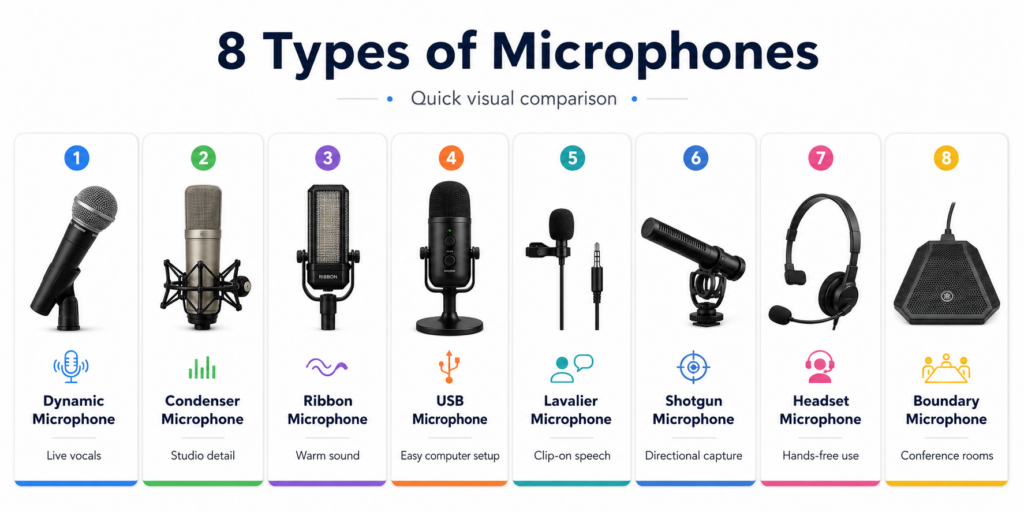
Microphone Types Comparison Table
| Type | Power Needed | Sensitivity | Durability | Best For |
|---|---|---|---|---|
| Dynamic | None | Lower | High | Live vocals, loud instruments |
| Condenser | Phantom/battery | High | Moderate | Studio vocals, acoustic detail |
| Ribbon | None (some need power) | Moderate-high | Low | Warm vocals, brass, guitar amps |
| Lavalier | Varies | Moderate | Moderate | Interviews, on-camera hosting |
| Shotgun | Varies | Moderate | Moderate | Film, outdoor video |
| USB | USB power | Varies | Moderate | Podcasting, gaming, beginners |
| Wireless | Battery | Varies | Moderate | Live events, fitness, theater |
| Boundary | Varies | Moderate | Moderate | Conference rooms, panels |
Which Microphone Type Should You Choose?
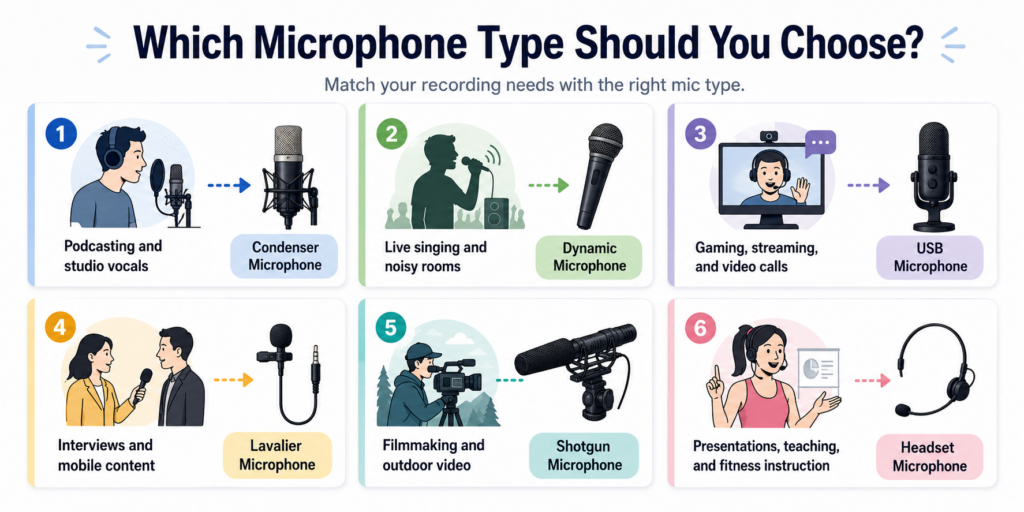
| Use Case | Best Microphone Type | Why |
|---|---|---|
| Podcasting | Dynamic or USB | Forgiving of room noise, easy setup |
| Gaming | USB | Plug and play, no extra hardware |
| Singing (live) | Dynamic | Durable, feedback-resistant |
| Singing (studio) | Condenser | Captures vocal detail and nuance |
| YouTube videos | Lavalier or shotgun | Hands-free or camera-mounted |
| Interviews | Lavalier | Consistent, hands-free pickup |
| Live events | Dynamic or wireless | Handles volume, allows movement |
| Conference rooms | Boundary | Captures multiple speakers evenly |
If you’re still deciding between the two most common starting points, our guides on dynamic microphones and condenser microphones go into more depth on which one fits a beginner setup best.
FAQ
What are the 3 main types of microphones?
The three most fundamental microphone types, based on how they convert sound into an electrical signal, are dynamic, condenser, and ribbon microphones. Every other category, like USB, lavalier, shotgun, and wireless, builds on one of these three core designs.
Which microphone type is best for vocals?
It depends on the setting. A dynamic microphone is generally the better choice for live vocals, since it handles loud volume and background noise well. A condenser microphone is generally the better choice for studio vocals, since it captures more detail and nuance in a controlled environment.
Which microphone is best for podcasting?
A dynamic or USB microphone is usually the better starting point for podcasting, especially if you’re recording in a room that isn’t acoustically treated, since dynamic capsules naturally reject more background noise than condensers.
What is the difference between dynamic and condenser microphones?
A dynamic microphone uses a magnet and coil design, doesn’t need external power, and is more durable and forgiving of loud sound or background noise. A condenser microphone uses a charged-plate design, needs phantom power or a battery, and captures more detail and sensitivity at the cost of picking up more ambient noise.
Are USB microphones good for beginners?
Yes. USB microphones are generally the easiest entry point into recording, since they connect directly to a computer without needing a separate audio interface or mixer.
Which microphone is best for YouTube videos?
It depends on the format. A lavalier microphone works well for hands-free, on-camera talking. A shotgun microphone works well when the mic can be mounted on or near the camera itself. Both are common choices among YouTube creators depending on the style of content.
Final Answer
There’s no single “best” microphone type, only the right type for a specific job. Dynamic mics handle loud, live, and unpredictable environments. Condenser mics capture studio-level detail. Ribbon mics add warmth.
Lavalier, shotgun, USB, wireless, and boundary mics each solve a specific practical problem, whether that’s hands-free speaking, camera-mounted video, beginner-friendly setup, freedom of movement, or capturing a full room. Once you know what you’re actually recording and where, the right type usually becomes obvious.