
Phantom power is an electrical signal sent to a microphone or other audio input device before it’s even switched on. Without it, many condenser microphones would only work at very short distances from their intended source, since signal loss across longer cables can otherwise drop below the noise floor of typical audio circuitry.
This guide covers what phantom power is, how it works, its advantages, and why so many microphones depend on it.
What Is Phantom Power?
Phantom power is the voltage that powers electret, condenser, and some ribbon microphones. It’s called “phantom” because it travels down the same microphone cable used to carry the audio signal back to a mixing board, rather than requiring batteries or a separate external power source.
The mixer itself draws power from a wall outlet, then sends a portion of that power down the cable to whatever device is connected to that channel, typically alongside a preamp circuit on the output side.
Phantom power is necessary because most condenser microphones simply won’t function properly without it. The voltage itself is the same type of DC voltage you’d find in a battery, just supplied directly from the mixer or preamp instead.
For more on how this connects to your broader setup, see our guide on what a microphone preamp is.
How Does Phantom Power Work?
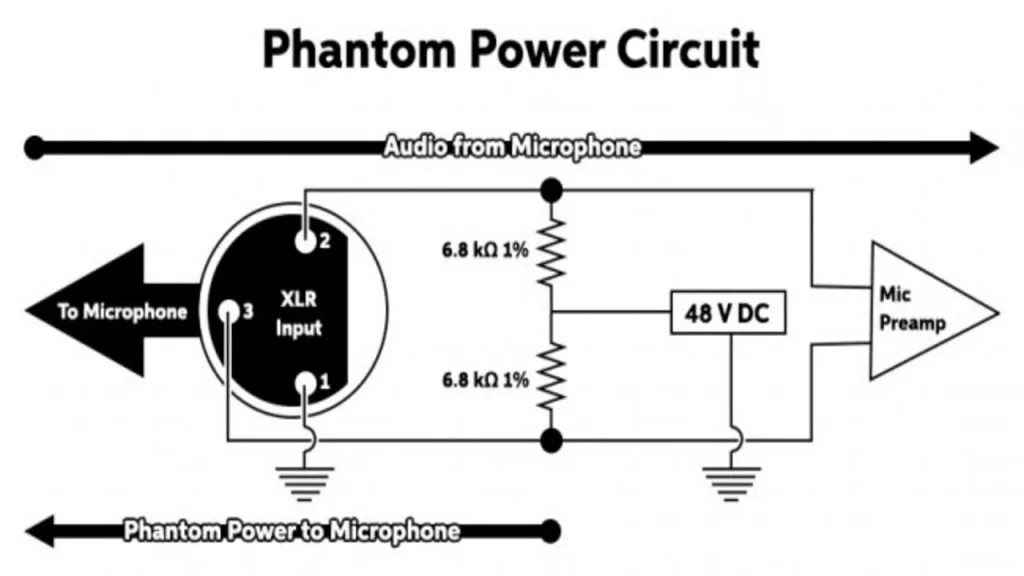
Powering an active or phantom-powered device requires a voltage between 12V and 48V DC, with the exact value depending on the specific microphone being used.
The voltage from the phantom power supply passes through a capacitor in series with a resistor, feeding into the microphone’s signal connection. DC current flows from the power supply through that capacitor and resistor to reach the mic.
Condenser microphones need a power source to operate, and while a small number of models can run on a single AAA or AA battery, most rely on phantom power supplied externally instead. For more on how condenser mics work overall, see our guide on what a condenser microphone is.
Advantages of Phantom Power
- Supplies power to microphones and other equipment through the same cable carrying the audio signal
- Essential for condenser microphones, including large-diaphragm tube condenser models
- Powers the active internal components found in active microphones
- Helps reduce the very high output impedance typical of condenser mic designs, which otherwise requires a powered circuit to manage properly
Most microphones can technically still operate without phantom power, but performance is often severely degraded, or the mic may not work at all. Condenser microphones generally require a high voltage, typically 48V, though the exact figure depends on the specific model.
Phantom power is necessary for condenser mics because their diaphragms need that higher voltage to stay properly charged. That voltage travels through the same cable carrying the signal back to the mixing desk or preamp.
What Does Phantom Power Actually Do?
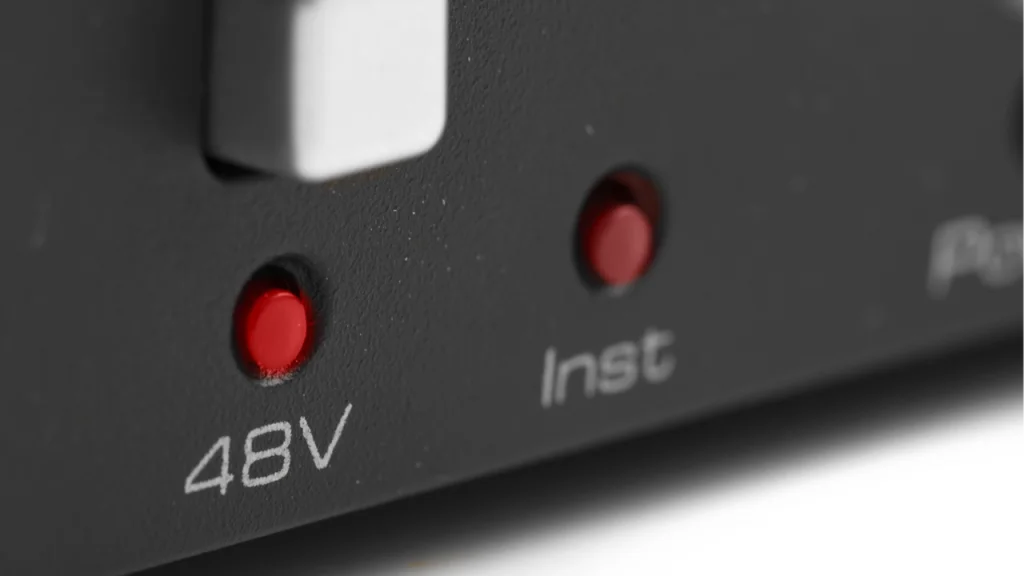
Phantom power essentially replaces the role a battery would otherwise play inside a condenser microphone, except the power comes from the mixer or preamp instead. It reaches the mic through a capacitor and resistor in the signal path.
Without phantom power, the resulting signal is much weaker, and in many cases unusable. It’s typically delivered to a microphone through its XLR cable, traveling down the same wire that carries the audio signal, usually through pin 2 on a standard mic-in connection.
Why Do I Need Phantom Power for My Microphone?
Phantom power is required for condenser mics because their diaphragms need a high voltage to stay charged, supplied through the same cable that carries the signal back to your mixing desk or preamp.
One important detail worth knowing is that phantom power applies equally across both audio channels. Since condenser microphones are specifically engineered to work with phantom power, they’re generally safe to use with any standard mixer that supports it.
Phantom power is especially useful when connecting a condenser mic that doesn’t have its own built-in power supply, since condenser designs require that extra voltage to function correctly.
FAQ
What happens if you don’t use phantom power?
Without phantom power, a condenser mic’s diaphragm isn’t polarized, meaning the electric field needed to convert sound into an electrical signal simply isn’t present. Dynamic microphones, by contrast, don’t rely on this same mechanism and don’t need phantom power at all.
Does phantom power matter?
For most people, it comes down to matching your microphone’s requirements with what your mixer or interface actually supports. Some ribbon mics, typically only found in studio settings, can be damaged by phantom power if a cable or the mic itself is wired incorrectly.
How do I know if my mic needs phantom power?
The simplest way to check is to confirm whether your microphone is a condenser type. If it is, it needs phantom power. If it’s a dynamic or ribbon microphone instead, it generally doesn’t.
Does phantom power improve sound quality?
Not directly. Phantom power simply supplies the additional voltage a condenser microphone needs to operate. It doesn’t reduce noise on its own, though it does provide the power boost necessary for the mic to record audio properly. Reducing noise typically requires other separate measures.
Does phantom power hurt dynamic mics?
A balanced dynamic microphone is generally unaffected by phantom power. An unbalanced dynamic mic, however, can be affected, though it’s unlikely to be damaged outright. It may simply not work correctly in that scenario.
Conclusion
Phantom power is essentially the flow of electricity to a device even when it appears to be powered off, traveling through the same cable that carries the audio signal rather than through a separate physical power connection. This is what allows a condenser microphone to draw power directly from a mixer or audio interface without needing batteries.
For more on related microphone fundamentals, see our guides on how to build a vocal booth, what a shotgun microphone is, and what a microphone array is.