
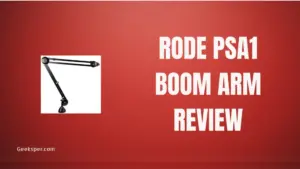
The Rode PSA1 is one of the most talked about boom arms on the market and has been compared against many other boom arms over the years. It is also one of the oldest boom arm designs still widely used today. We tested the Rode PSA1 to see how it holds up for desk and studio setups.
This review covers the PSA1’s features, performance, pros, cons, and whether it is worth buying.
If you want to see how it stacks up against other boom arms, our comparisons of Blue Compass vs Rode PSA1 and Samson MBA38 vs Rode PSA1 cover those directly.
Rode PSA1 Boom Arm Review
Rode is a brand familiar to most people in the audio industry, having produced electronic products for a long time with a recognizable vintage and classical styling approach.
The PSA1 is one of Rode’s most popular products and has become something of a benchmark for newer boom arms entering the market. It was launched well over a decade ago and remains popular thanks to its vintage design and classic styling.
In our testing, the PSA1 suited a wide range of desk and setup conditions, and it remains a favorite among many professionals and artists. It is known for its stability, with no noise or external pressure issues during use, and it includes desk mounting options.
The boom arm uses a two-axis swivel mount for accurate microphone positioning, allowing it to be handled without generating noise. If your setup requires frequent repositioning in a studio, the PSA1 is one of the strongest choices available.
Features of the Rode PSA1
Here are the core features that stood out in our testing.
Design
The boom arm has a unique, vintage style that looks attractive and fits well with most types of setups.
33-Inch Arm Length
The PSA1 has an arm length of 33 inches, which is more than enough reach for most desk setups.
Super Flexible
In our testing, the boom arm moved easily around the desk or table with very low self-noise, making repositioning simple.
4.4 lbs Weight Handling
The PSA1 can handle up to 4.4 lbs (around 2kg), which is a notably high capacity compared to many boom arms on the market.
2-Axis Swivel Mount
The two-axis swivel mount allows for accurate microphone positioning, making it easier to dial in the right angle.
No Noise
During testing, we did not notice any noise from the boom arm while moving or rotating it, which is one of its standout qualities.
For more boom arm options, see our guide to 5 best microphone boom arms.
Pros and Cons
Pros
- Classic, attractive design
- Flexible movement around the desk
- 33-inch arm length
- Handles up to 4.4 lbs of weight
- Accurate positioning
- No noise or vibrations
- Strong positive feedback from users
Cons
- None significant found in our testing
FAQ
Is the Rode PSA1 worth it?
Yes. Based on our testing, the PSA1 offers nearly everything you would want from a boom arm, combining reach, stability, and a durable design.
How long is the Rode PSA1?
The Rode PSA1 has an arm length of 33 inches, which is more than enough for most desk and studio setups.
How do you use a Rode PSA1?
No special setup is needed. Attach your microphone to the boom arm, then attach the boom arm to your desk or table, and it is ready to use.
Conclusion: Should You Buy the Rode PSA1?
Based on our testing, we would recommend the Rode PSA1 without much hesitation. It performs well across design, flexibility, weight handling, and noise control, making it a worthwhile investment for improving your recording setup.
Before buying, check the latest price and availability, since pricing and product availability can change over time. If you are also considering other boom arms, see our guide to 5 best microphone boom arms for more comparisons.